Arts, cultural and human rights advocacy and governance were the key themes of my 2025 writing year (with a little bit of poetry here and there).
Festivals, etc
The implosion of Adelaide Writers Week in January 2026 has provided a startling reminder of the importance of writers’ festivals to the Australian literary landscape (and of their startling fragility).
So I was delighted to book four festival appearances in 2025, including an Emerging Writers Festival conversation on how to sustain a career in the arts hosted by Overland Literary Journal. The frank and insightful conversation with Cher Tan, Luke Horton and Aviva Tuffield was particularly sobering given it has never been harder or a more dangerous a time to be a writer in the world. I was also thrilled to facilitate a conversation about writing, accessibility and disability representation with Carly Findlay and Eli Sutherland at the Odyssey Literary Fest.
It was a great disappointment to have to withdraw from the Bendigo Writers Festival, where Cher Tan, Madison Griffiths and I were meant to to discuss Looking at Women Looking at War by the late Ukrainian writer Victoria Amelina as part of the Cities of Literature Book Club. Unfortunately, while the panel was later rescheduled by Readings as part of A Day in Carlton, it had to be cancelled again due to personal reasons. (But watch this space for further updates coming soon).
Reviews and resources
I unlocked a long-held writing goal in 2025, which was to have a piece published in The Guardian (perhaps one of the least-dreadful examples of remaining legacy media). As a Kerry Greenwood fan, I was delighted to be asked to review the final book in her Phryne Fisher mysteries, though disappointed when a single sentence was enough to derail an otherwise enjoyable reunion.
‘There are plenty of progressive views on feminism, migration, illegitimacy and queerness in this book; Phryne even condemns the false conflation of homosexuality and paedophilia, which “aren’t the same thing at all”. Unfortunately, having rightly separated them, Greenwood then attempts to explain: “Sometimes they get mixed up, because men are so frightened of the idea that they fancy men that their emotions get directed towards children instead.”
This disappointing fumble appears to imply that gay men can accidentally fall into paedophilia and erases straight male perpetrators entirely, which could leave readers to assume that most child sexual abusers are gay men (which is untrue). “What poppycock,” I only wish Phryne had replied, or that Greenwood had struck out the sentence entirely. (It’s not hard to imagine this may have been picked up, if not for the timing of her death.)
Meanwhile, my most-read resource of 2025 was the updated list of Aussie publishers on my website.
The art of governance
2025 was another massive year of governance conversations and provocations. In addition to completing the first draft of my governance book (!!!), I continued my work on Palestine as a governance issue, saw my rant on strategic planning make it onto the US-based Scene Change blog, and returned to ArtsHub and the Take on Board podcast to talk about the ethics of Generative AI when it comes to arts, cultural and non-profit governance.
I released 10 governance rants on my ‘And Another Thing’ vlog (the full versions and archives of which are exclusively available to my Patreon supporters):
- And Another Thing: succession planning
- And Another Thing: the merit of merit
- And Another Thing: receiving and responding to harm
- And Another Thing: AI and governance
- And Another Thing: from censorship to systemic change
- And Another Thing: Strategic Plans vs strategic planning
- And Another Thing: Model (rule) minimums
- And Another Thing: illegal online board meetings
- And Another Thing: low bar for board diversity
- And Another Thing: should board members get paid?
I was delighted to find my governance work referenced in the words of my colleagues, including David Pledger’s call to stop censoring artists in ArtsHub. And the video of my TedX talk on why (nearly) everything you thought you knew about boards and governance is wrong* was the most-visited new post on my website last year.
As usual, if any particular governance issues are irking or inspiring you, I’d love to hear about them.
Arts and human rights advocacy
Once again, advocacy felt like a full-time job in 2025.
In addition to my governance work, I spent an unexpected amount of the year banging on about the (lack of) ethics of Generative AI, including And Another Thing rants on And Meta’s Grand Theft AusLit and AI and governance, arguments in ArtsHub, my Take on Board interview, and submission on the Productivity Commission report on copyright and AI.
I also contributed to advocacy around the 2025 election, Disability Discrimination Act Review, Melbourne City Council’s draft 2025–29 Council Plan, and the Australian Government’s human rights abuses at home and overseas, and lobbied against some appalling new laws – including the teen social media ban that is more about surveillance and censorship than safety, removal of guardrails from social media and AI providers, a Trump-like offshore detention and mass deportation bill, new Adult Time for Violent Crime legislation, and the (since rescinded) designation of Melbourne CBD as a police stop-and-search area.
I made it into the news (and Hansard) for ‘The Larsen Report’ that preceded the closure of Meanjin, and into the final report on the Victorian Government’s inquiry into cultural and creative industries in Victoria, which found (unsurprisingly) that it has never been harder for Victorians to make a living in the cultural and creative industries. On that note, I continued my advocacy around Australia’s national workforce crisis, including And Another Thing rants on strategic venting and collegiality as care and why self care isn’t (always) selfish.
Happy 1st birthday to The RITP
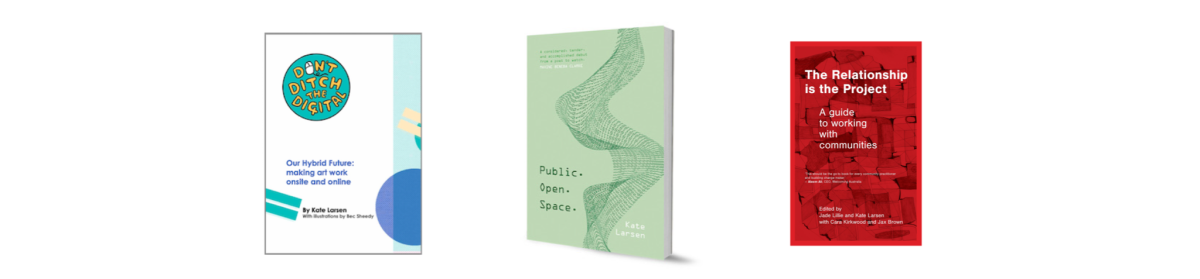
In March, we celebrated one year of the expanded second edition of The Relationship is the Project with NewSouth Publishing, followed by a wonderful review on the Professional Historians Australia website in May:
‘The strength of this book lies in its breadth. Much like the diverse communities represented in its 32 chapters, The Relationship is the Project demonstrates the principles it describes. Featuring the foundational tenets of community-engaged work, but going beyond these, the chapters explore important questions including working with First Nations communities, cultural safety, intersectionality and self-determination. These early chapters set the tone for the rest of the book, which foregrounds the importance of relationality and self-reflection as essential practices for the work we do with communities.’ – Nikita Vanderbyl
Happy 2nd birthday, Public. Open. Space.
In June, it was two years since my debut poetry collection, Public. Open. Space. was published by Fremantle Press. But the year began with a thoughtful review in Westerly:
‘Public. Open. Space. remains stubbornly physical, paper and ink. Yet Larsen’s poetics—and politics—span the gap between the tangible and digital worlds in a way that embodies the inherent strangeness of the glitch. In so doing, her collection manages to resist many of the traps writing about the internet can entail. It flickers in and out of itself like a line of corrupted computer code; a nervous, electric rhythm.’ – Ellie Fisher
Misc bits
It was a relief to feel the first stirrings of poetry in my polycrisis-bludgeoned brain throughout the year. And I was particularly delighted to collaborate on a musical reinterpretation of Banned. With. from Public. Open. Space. with my dear friend Gennaro Sallustio (aka Absent on Arrival).
I hope you found the words you needed last year. I look forward to reading more of them in the writing year to come.
Subscribe or support
For future updates, subscribe to my free occasional enews.
If any of my work or writing has been of value to you, I’d appreciate you joining me as an advocate, ally or accomplice from just $2.50/month on Patreon).

 LARSEN | KEYS