At last month’s Perth Festival Writers Week in Boorloo/Perth, I began my Tiny Little Digital Poetry workshop with the following:
Given Perth Festival Writers Weekend brings writers and readers together in a colonial city built on unceded Noongar Boodja, it’s impossible as a guest writer not to acknowledge that our writing colleagues here and overseas are currently being killed, threatened and censored at unprecedented rates.
This includes: more than 100 Palestinian and multi-national journalists killed by Israel in the last few months alone – the largest number in the history of modern warfare; the ongoing incarceration of Julian Assange for reporting on another unjust military incursion; the recent sentencing of Australian journalist Yang Hengjun to death in China; and artists, writers, actors, academics and journalists here in Australia who have been fired or denied work, censored or censured for expressing their support for Palestine.
This may feel like an overtly political way to begin a writing workshop. But writing – like all art – is inherently political: in who’s stories get told, who tells them and how, in who decides, and who gets to access them. Which makes social media and other digital platforms inherently political too, including how platforms are monitored, censored and controlled.
We are all here because we love writing, so I cannot imagine there being any disagreement on the principles at heart of all of these big issues: That writers have a right to life and livelihood. That their stories are important and necessary. And that if we want to be safe and for our stories to be told, we have an obligation to fight for those same rights for others too.
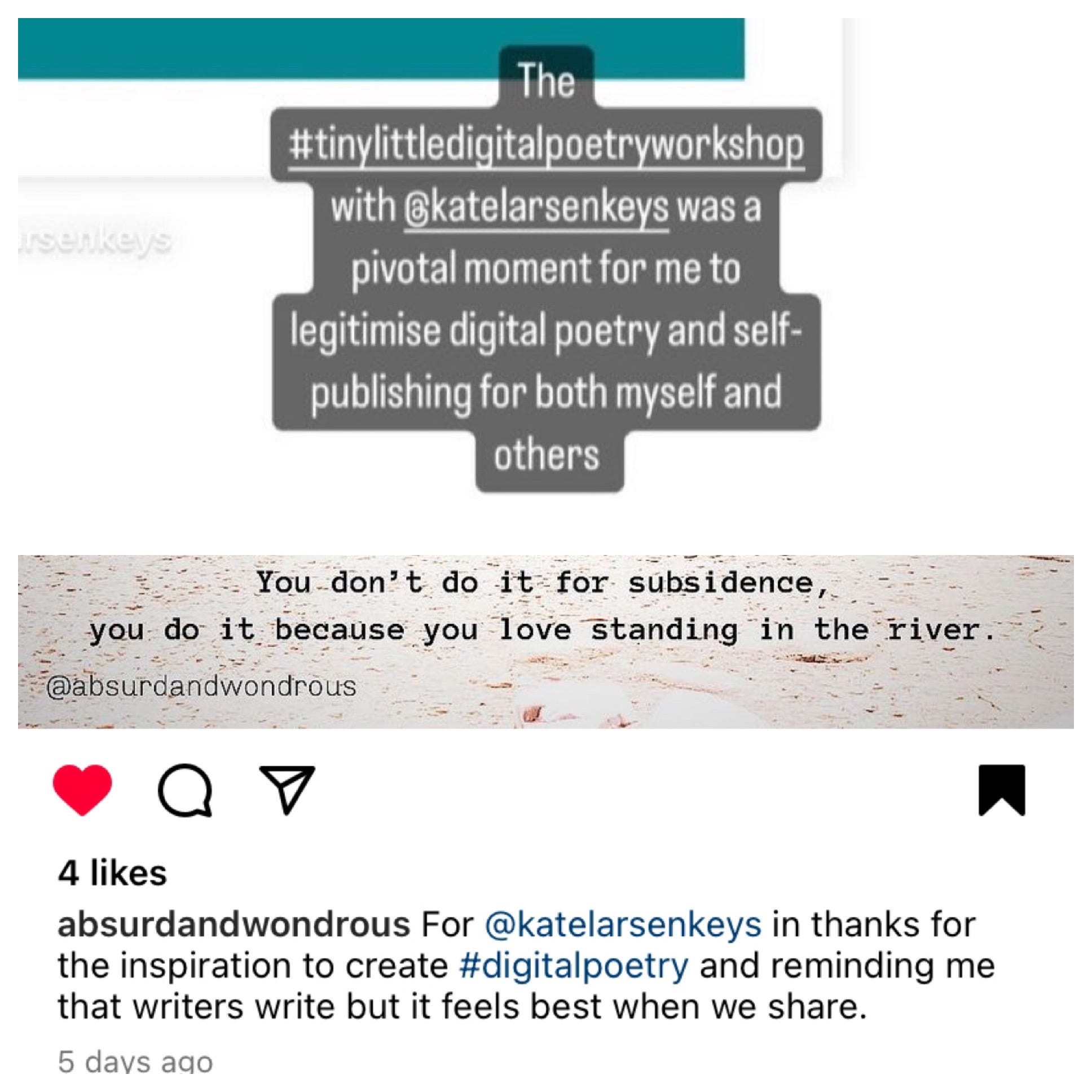
I was grateful to be able to point to powerful, of-the-moment examples from Omar Sakr, Rupi Kaur and Rafaat Alareer (even as we mourn his horrific loss – vale vale vale). And delighted to see participants getting onboard (and online) in celebration of the immediacy, politics and possibilities of digital poetry. Give Julz, Malissa, Melissa, Sky and Ash a follow for more.
If you’re in a position to do so, you can donate to the Gaza Journalists Appeal via the MEAA website.
Further reading: Palestine as a governance issue
You can check out all of the articles and resources in this series, which include:
- And Another Thing: issues with appointed boards, January 2026
- Writers festival reflections, October 2025
- Take on Board podcast on the ethics of AI, August 2025
- Why we cancelled our Bendigo Writers Festival panel, August 2025
- And Another Thing: from censorship to systemic change, June 2025
- And Another Thing: receiving and responding to harm, March 2025
- Contextually fine, October 2024
- And another thing: board solidarity, October 2024
- The statements we make, August 2024
- And another thing: SLV as the example you don’t want to be, August 2024
- And another thing: organisational ethics and deficit areas, July 2024
- And another thing: on cultural safety, May 2024
- Take on Board podcast on Palestine as a governance issue, May 2024
- Palestine governance resources in The Commons, April 2024
- The power of digital poetry, March 2024
- Dear arts organisations, January 2024
- Board members, we need to talk about Palestine, December 2023
- Ally is a verb, October 2023
Subscribe or support
For future updates, subscribe to my free occasional enews.
If any of my work or writing has been of value to you, I’d appreciate you joining me as an advocate, ally or accomplice from just $2.50/month on Patreon).

 LARSEN | KEYS
19 thoughts on “The power of digital poetry”